
Author name: editor

Cecil B De Mille Multiple Talents | Cecil B De Mille As Radio Drama Director | Lux Radio Theater Info
1941, Pic Magazine, Radio History

Cecil B. DeMille Tries his Hand at Radio
(Pic Magazine, 1941)

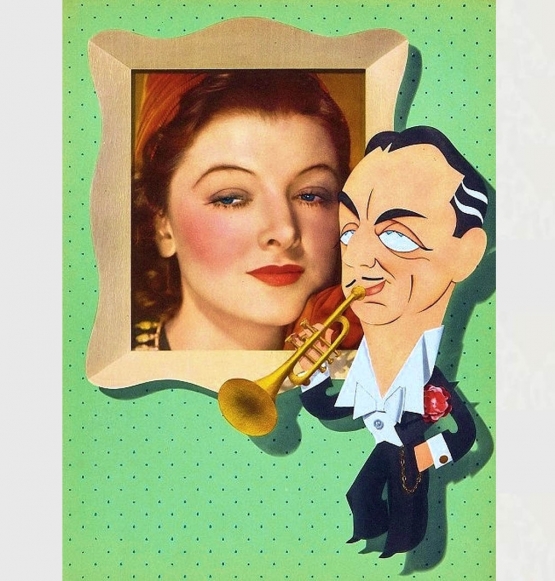
At the age of 63, after 44 years in show business, and ten years as director of the Lux Radio Theaterstyle=border:none, Cecil B. De Mille is still producing. He can’t stop and he probably never will. He is first, last and all the time a showman. The show business is in his blood, and whether he is on a set or taking his leisure at home, his heart and mind are in the theater. He loves to have people around him so that he can play a part, for consciously or unconsciously, he is always acting… C.B.’s father was an actor and playwright, and later a partner of David Belasco. His mother was an actress, and later a very successful play agent.

1937 Radio Programming | 1930s Radio Production
1937, Pathfinder Magazine, Radio History

The State of Radio In 1937 America
(Pathfinder Magazine, 1937)

Girding the United States today are two major national radio chains and one smaller chain. They are the National Broadcasting Company, the Columbia Broadcasting Company and the Mutual Broadcasting System, NBC, with its combined Red and Blue networks, has about 110 stations. CBS on a single network has 101. Mutual has 45 and will add a new section of 10 more next month.

Advertisement

Use shortcode [oma_ad position="summary_top"] (or other position) in your theme or widgets to display OMA Promotions here.

Fears of a Stalin/Mosadegh Alliance... (People Today, 1951)
1951, People Today Magazine, Spies

Fears of a Stalin/Mosadegh Alliance…
(People Today, 1951)

The attached article will give you some indication as to the high level of anti-Soviet intensity that existed in the U.S. in 1951. This short piece, and others like it, fanned the fires that lead to the downfall of Iranian Prime Minister Mohammad Mosaddegh (1882 – 1967) in the well-known 1953 coup that was launched by both the CIA and MI5. The results of of this joint effort (Operation Ajax) were fruitful in the short run, but set in motion a series of events that have created the Iran we enjoy today.


Illustrated with a military-style map, abounding with footnotes and an ominous-looking red Soviet arrow, rudely pointing at the Abadan oil fields, the uncredited journalist hinted that Mosaddegh’s rise and subsequent nationalization of all foreign-owned oil wells would only create a new Iran that was firmly in the Soviet camp. This was not to be the case, for Mosadegh really never trusted the Reds.

Advertisement

Use shortcode [oma_ad position="summary_top"] (or other position) in your theme or widgets to display OMA Promotions here.

'The Thin Man'' (Stage Magazine, 1937)
1937, Hollywood History, Stage Magazine

‘The Thin Man”
(Stage Magazine, 1937)

Attached is an article by One Take Woody (Woodbridge Strong Van Dyke, Jr. 1889 – 1943) on the topic of the two Thin Man films he had directed:

Looking back into the infinite past, I seem to recall that a certain motion picture was made and that I had something to do with it. It stirs restlessly in my memory, for it was immediately seized by the theater public as a new cycle in screen entertainment. In Hollywood, things are often done in cycles – gangster cycles, G-man cycles, historical romances, sea stuff,even Shakespeare. Somebody starts it and others fall in line to catch the shekels that bounce to the floor after the first jack pot.


Click here to read an article about Dashiell Hammett.

Advertisement

Use shortcode [oma_ad position="summary_top"] (or other position) in your theme or widgets to display OMA Promotions here.

Ginger Rogers (Film Daily, 1939)
1939, Film Daily Magazine, Hollywood History

Ginger Rogers
(Film Daily, 1939)

A single page article on the topic of Ginger Rogers (1911 – 1995) and her career as it had progressed up to the year 1939:

Virginia Katherine McMath is the real name of this famous star and she was born in Independence, Missouri, on July 16, but most of her childhood was spent in Fort Worth, Texas.

She is five feet, four inches tall and weighs 108 pounds. She never has to diet because dancing keeps her in perfect condition. Dancing is listed as her very favorite hobby, too.

She had her first taste of real success on the screen with the winning roles in ‘Gold Diggers of 1933′ and ’42nd Street’.


Click here to read about the young Lucile Ball.

Mickey Mouse: Goodwill Ambassador (Stage Magazine, 1935)
1935, Stage Magazine, Walt Disney

Mickey Mouse: Goodwill Ambassador
(Stage Magazine, 1935)

Seven years after his film debut in Steamboat Willie, Mickey Mouse continued to pack the theaters of the world. Prior to the release of Disney’s animated film,William Tell, STAGE MAGAZINE correspondent Katherine Best was rightfully in awe over the world-wide popularity the rodent was enjoying and at the time this essay appeared in print, he had already been seen in over sixty cartoons.

1930, Photoplay Magazine, Walt Disney

International Movie Star – Mickey Mouse
(Photoplay Magazine, 1930)

Although Euro Disney would not be opening until 1990, this article by Hollywood costume designer Howard Greer implied that it would have done quite well had they opened eighty-six years earlier:

You know everyone in Hollywood? they asked. I blushed modestly and admitted that I did.

Don’t you want to know about the stars? I went on.Shall I tell you about Garbo?

‘A smile passed across their faces.’
‘Garbo? Yes, we like her. But the star we ‘d love to know everything about is – Mickey Mouse!’

Advertisement

Use shortcode [oma_ad position="summary_top"] (or other position) in your theme or widgets to display OMA Promotions here.

Russian Composers Preferred by Rimsky-Korsakov (Review of Reviews, 1912)
1912, Music History, The American Review of Reviews

Russian Composers Preferred by Rimsky-Korsakov
(Review of Reviews, 1912)

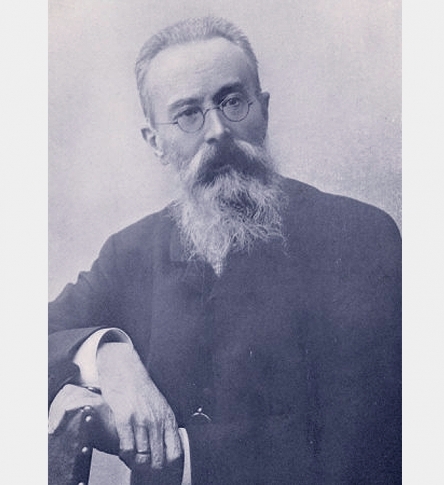
For those of you looking for some dish in the music history department, this article recounts a conversation between Rimsky-Korsakov (1844 – 1908) and Leo Tolstoy (1828 – 1910) as to which Russian composer Rimsky-Korsakov preferred the best: Anton Rubinstein or Peter Tschaikovsky. Opinions flew in all directions and many more names were dropped before the conversation came to a close…

1938, Design, The Art Digest

The Bauhaus Exhibit at the Museum of Modern Art
(Art Digest, 1938)

To mark the opening of the Museum of Modern Art’s 1938 exhibition, Bauhaus 1919 – 1928, the over-paid editors at ART DIGEST published this single page review for it’s American readers explaining what the art school was, why it closed and what was in the mind of the school’s founder, Walter Gropius (1883 – 1969):

The Bauhaus program proceeded to teach students manual dexterity, in all the crafts, to investigate the laws of the physical world, to plumb the spiritual world, and to master the machine. Out of the Bauhaus came the first experiments in tubular furniture, in modern typography, in modern lighting, and many significant developments in architecture, photography, abstract art, textile and other crafts.


Click here to read unfavorable criticism about the Bauhaus exhibit.

N.Y. Public Library Dime Novel Exhibition 1922 | Beadle and Adams Dime Novel History
1922, Dime Novels, The New Republic

NY Public Library Exhibits Dime Novels
(The New Republic, 1922)

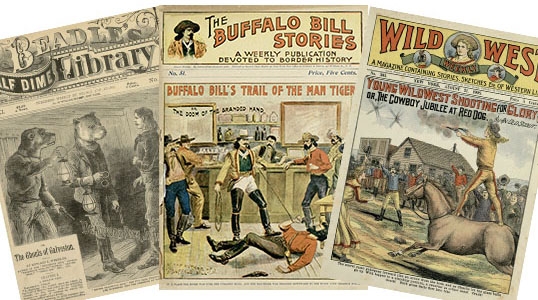
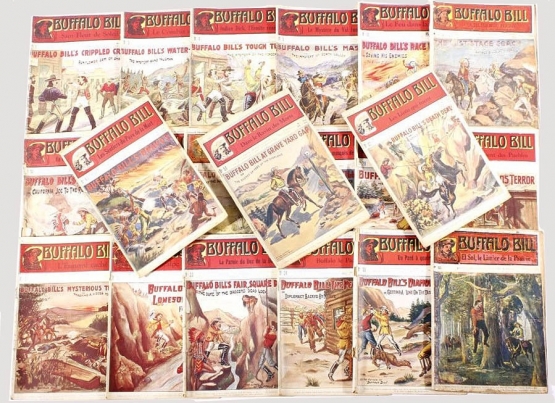
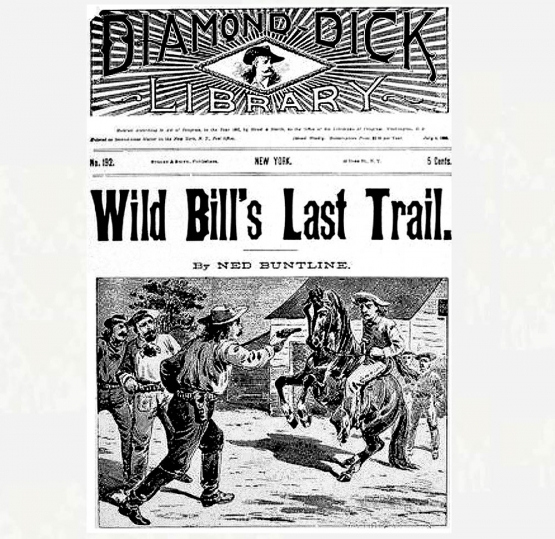
Time is the satirist in its recompense as in its revenge. Who of that youthful generation who read Dime Novels stealthily and by night, with expense of spirit and waste of shame, imagined that he would one day review his sins by broad daylight in the exhibition room of the New York Public Library? The thin volumes which were wont to lie so flat under pillows or slip so readily into pockets are now enshrined in glass case, and the yellow covers and inky pages which suffered such persistent search and seizure and were burnt so freely as literary garbage are now gathered and appraised as prizes of the bibliophile.

Advertisement

Use shortcode [oma_ad position="summary_top"] (or other position) in your theme or widgets to display OMA Promotions here.

Dime Novels Explained | Chronicle of Dime Novels | Outline of Dime Novels
1937, Dime Novels, The Literary Digest

Library of Congress Salutes the Dime Novel
(Literary Digest, 1937)

In 1937 the Rare Book Department at the Library of Congress launched a surprising exhibit of what they called, ephemeral literature – these works were popularly known as Dime Novels and they were not simply the father of the modern comic book but also the father of one other form of popular literature:

The roots of the American historical novel are sunk in the so-called dime novel – the first effort at popular fiction. It began with the stories based on the Revolutionary War, then historical fiction of incidents in the War of 1812, the Mexican War and the struggle for Cuban independence, which stated about that period.

DIME NOVEL HISTORY | DIME NOVEL American Popular Culture
1900, Dime Novels, The Literary Digest

‘Rise and Fall of the Dime Novel”
(Literary Digest, 1900)

Although the dime novel was in full swing as a popular form of mass literature in 1900, the journalist titled this article as he did because the genre was undergoing so many changes at the time, departing from it’s original format. A short history of the dime novel is provided with an emphasis on it’s classic period spanning the years 1860 through 1870:


Some references are also made to the work of the Beadle and Adams bookkeeper, George Munro, who completely changed the direction of the dime novel when he took up the pen in 1865.

E.E. Cummings on T.S. Eliot (The Dial Magazine, 1920)
1920, The Dial Magazine, Twentieth Century Writers

E.E. Cummings on T.S. Eliot
(The Dial Magazine, 1920)

A review of T.S. Eliot‘s (1888 – 1965) second collection, Poemsstyle=border:none (1919), as reviewed by E.E. Cummings (1894 – 1962) in the well respected magazine of the arts, THE DIAL. It was in this volume that Eliot’s well remembered series of quatrains first appeared: Sweeney Among the Nightingales, Sweeney Erect The Hippopotamus and Mr. Eliot’s Sunday Morning Service.

Cummings at that time was living in Paris and writing his first book, The Enormous Roomstyle=border:none, which would be published in 1922. The review of that work can be read here.

Advertisement

Use shortcode [oma_ad position="summary_top"] (or other position) in your theme or widgets to display OMA Promotions here.

Scroll to Top