Author name: editor

William Butler Yeats Interview | WB Yeats interviewed Theater Arts Magazine 1924
1924, Theatre Arts Magazine, W.B. Yeats

William Butler Yeats Interviewed
(Theatre Arts Magazine, 1924)

When the writer and editor Montrose J. Moses (1878 – 1934) got some quality time with the fifty-four year old poet and playwright William Butler Yeats (1865 – 1939) they discussed Irish theater, contemporary poetry, the collective literary merits of their generation and a good deal more. Unlike their visits in earlier days, Yeats was by then a respected icon in the republic of letters (having been awarded the Nobel Prize for Literature a year earlier).

John Maynard Keynes on the Versailles Treaty (Current Opinion, 1922)
1922, Current Opinion Magazine, Versailles Treaty

John Maynard Keynes on the Versailles Treaty
(Current Opinion, 1922)

A magazine review of John Maynard Keynes book, A Revision of the Treaty (1922). The reviewer wrote that it lacks the prophetic fire of it’s author’s earlier book, The Economic Consequences of the Peace, but continues the argument of that book:

Mr. Keynes claims that almost everyone now has come around to his point of view. We practically all recognize, he says, the over-severity of the reparation clauses written into the Versailles Treaty.

Advertisement

Use shortcode [oma_ad position="summary_top"] (or other position) in your theme or widgets to display OMA Promotions here.

The Ongoing French Occupation of Germany (Literary Digest, 1928)
1928, The Literary Digest, Versailles Treaty

The Ongoing French Occupation of Germany
(Literary Digest, 1928)

The attached article, written in 1928, reported on how heartily sick the Germans were at having to serve as hosts for three occupying armies as a result of a Versailles Treaty clause that mandated the Allied military occupation until 1935. The Foreign Minister of Germany, Dr Gustav Stresemann, made several eloquent pleas to the diplomatic community insisting that there was no need for the continuing encampments before he began submitting his bitter editorials to assorted European magazines, which are discussed herein:

Friendship between France and Germany is impossible as long as Allied troops remain in the occupation area of the Rhineland…
Advertisement

Use shortcode [oma_ad position="summary_top"] (or other position) in your theme or widgets to display OMA Promotions here.

What Hitler Wanted (Omnibooks Magazine, 1942)
1942, Adolf Hitler

What Hitler Wanted
(Omnibooks Magazine, 1942)

Hearst reporter H.R. Knickerbocker (1898 – 1949) had been closely watching Hitler since 1923 and pointed out that on April 29, 1941 the Axis forces had printed a trial balloon on the pages of the JAPAN TIMES ADVERTISER that clearly indicated the peace terms that were acceptable to the Nazis. Attached is Knickerbocker’s outline of this proposal, as well as the correspondent’s astute commentary that he had prepared for his 1942 bestseller, Is Tomorrow Hitler’s?


From Amazon: Is Tomorrow Hitler’s?style=border:none:


The German economist who made the Reich’s rearmament possible was named Hjalmar Schacht, click here to read about him…

A Military Genius? (Ken Magazine, 1939)
1939, Adolf Hitler, Ken Magazine

A Military Genius?
(Ken Magazine, 1939)

This is a small segment from a longer article on this site that can be read here.
Just months prior to the start of the Second World War, this anonymous correspondent asked, Is Hitler a strategic genius? For much of the following year many of Europe’s anointed would find themselves asking much the same question; but this reporter was not impressed with the man one jot and wished his readers to keep in mind that throughout the slaughterous environment provided by the Entente Powers of the 1914 – 1918 war, Hitler was entirely unable to rise above the rank of corporal – in spite of the fact that his regiment was losing a sergeant each day.


From Amazon: Hitler’s First Warstyle=border:none.

What is Next for Europe? (Literary Digest, 1933)
1933, Adolf Hitler, The Literary Digest

What is Next for Europe?
(Literary Digest, 1933)

Can we trust him?

That is the question asked by some British and French editors as they consider Chancellor Adolf Hitler‘s speech on the disarmament question in which, while he firmly champions the German case for equality in armaments, ‘he broke no diplomatic china’


The German economist who made the Reich’s rearmament possible was named Hjalmar Schacht, click here to read about him…

Advertisement

Use shortcode [oma_ad position="summary_top"] (or other position) in your theme or widgets to display OMA Promotions here.

Hitler Comes to Power 1933 | European Opinion Regarding Chancellor Adolf Hitler | Hitler Chancellor of Germany
1933, Adolf Hitler, The Literary Digest

1933: Hitler Comes to Power
(Literary Digest, 1933)

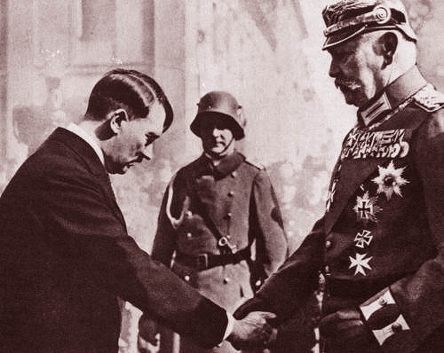
This magazine article appeared on American newsstands not too long after Hitler was sworn in as Chancellor in the office of President Hindenburg (Paul von Hindenburg 1847 – 1934), and presents a number of opinions gathered from assorted European countries as they considered just what a Nazi Germany would mean for the continent as a whole:

‘Whether or not Hitler turns out to be a clown or a faker, those by his side now, and those who may replace him later, are not figures to be joked with.’

With this grim thought the semiofficial Paris ‘Temps’ greets the accession of ‘handsome Adolf’ Hitler to the Chancellorship in Germany. The event, it ads, is ‘of greater importance than any event since the fall of of the Hohenzollererns.’

Click here to read a similar article from the same period.

Hermann Goering Named as 'Economic Dictator' (Literary Digest, 1936)
1939, Ken Magazine

The Growth of the German Airforce
(Ken Magazine, 1939)

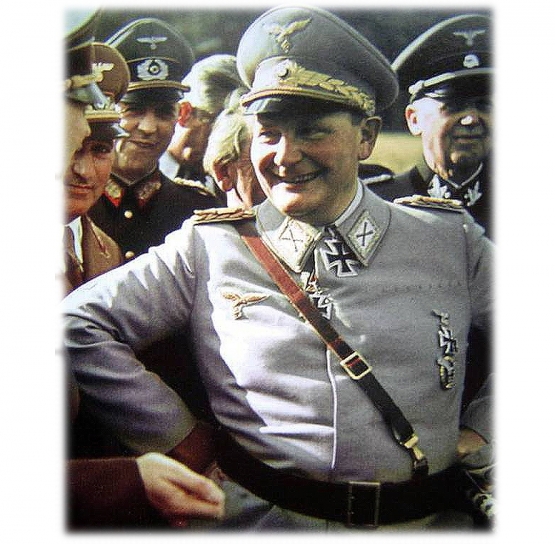
Published four months before Germany’s attack on Poland (September 1, 1939), this article outlines Hermann Goering’s efforts to build the Luftwaffe from scratch, the creation of various flight schools, the Luftwaffe collaboration with the Hitler Youth organization, and his aspirations to out-class the air forces of the United States and Britain. The article also addresses the business dealings of American manufacturers Boeing and Douglas Aircraft had with the German Luftwaffe.


Click here to read about the corrupt American corporations that aided the Nazi war machine during the 1930s.

1930s Global Arms Race
1937, Pathfinder Magazine

The Arms Race
(Pathfinder Magazine, 1937)

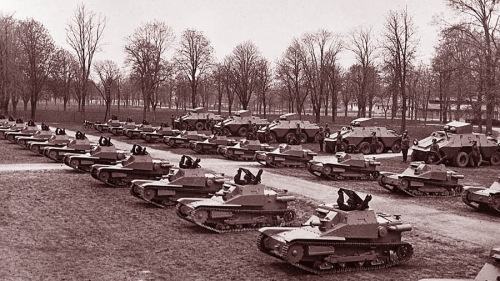
Stirred by [the] Japanese invasion of Manchuria in 1931 and by subsequent German scrapping of the Versailles Treaty, military experts of every nation have been altering the smallest details of army life to make their forces bigger, faster and more deadly than those of their neighbors.

Nowhere was there any indication that the pace of armaments might slacken. No nation gave any sign of dropping out of the race.


The economist who made the German rearmament possible was named Hjalmar Schacht, click here to read about him…

Advertisement

Use shortcode [oma_ad position="summary_top"] (or other position) in your theme or widgets to display OMA Promotions here.

Military Buildup in Germany (Ken Magazine, 1939)
1939, Ken Magazine, The Nazis

Military Buildup in Germany
(Ken Magazine, 1939)

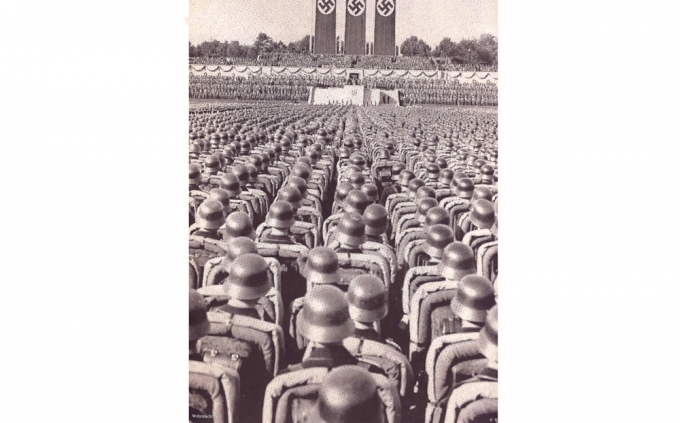
The German Army is the greatest enterprise in the world. It has a million employees on it’s payrolls, the active officers and soldiers, and, at a conservative estimate, feeds another million workers in the munitions industry. Actually the army employs all of Germany. Military needs alone determine the way of life in the besieged fortress into which 80 million Germans have more or less willingly formed themselves.


The German economist who made the rearmament possible was named Hjalmar Schacht, click here to read about him…

Beer Flowed the Week Prohibition Ended (Literary Digest, 1933)
1933, Repeal, The Literary Digest

Beer Flowed the Week Prohibition Ended
(Literary Digest, 1933)

The attached article is composed of numerous newspaper observations that appeared in print throughout April of 1933; these perceptions all pertain to the goings on that followed in the joyous wake of Prohibition’s demise:

‘The return of beer has really been a remarkable phenomenon,’ says The New York Evening Post.
‘Not one of the bad effects predicted for it actually took place’.

Liberace Arrives (Collier's Magazine, 1954)
1954, Collier's Magazine, Interviews: 1912 - 1960

Liberace Arrives
(Collier’s Magazine, 1954)

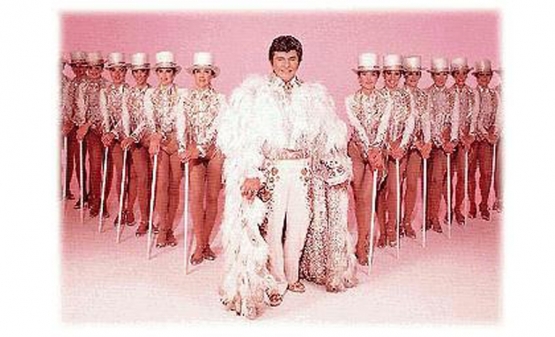
Attached is a five page interview with the always demure and introverted pianist Liberace (b. Wladziu Valentino Liberace: 1919 – 1987). When this article first appeared on the pages of COLLIER’S MAGAZINE, no living performer was selling more records than he was, his television program was nearing its second year and American women had not yet figured out that he was gay. Life was good.


From Amazon: Liberace: An American Boystyle=border:nonestyle=border:none

Advertisement

Use shortcode [oma_ad position="summary_top"] (or other position) in your theme or widgets to display OMA Promotions here.

Congress Discusses the Repeal of Prohibition (Literary Digest, 1933)
1933, Repeal, The Literary Digest

Congress Discusses the Repeal of Prohibition
(Literary Digest, 1933)

During the action-packed opening months of the F.D.R. administration, Congress addressed the option of repealing Prohibition and allowing each state to decide whether it wished to be dry or wet:

Now the people can decide, after more than thirteen years of Prohibition.

Surprising the country, the lame-duck Congress, hereto staunchly dry, reverses itself ‘in a stampede toward repeal,’ to permit the people to decide Prohibition’s fate.

Memories of Prohibition 1945 | Prohibition Recollection Article
1932, Pathfinder Magazine, Repeal

Talk of Repeal on Capitol Hill
(Pathfinder Magazine, 1932)

During the summer of 1932, Democratic Senator Carter Glass (1858 – 1946) turned heads and dropped jaws on Capitol Hill when he introduced a piece of legislation that was intended to water-down the 18th Amendment. Glass, a devoted enemy of the swizzle stick, proposed an amendment to the Constitution that would continue to outlaw saloons nationally while permitting hootch to flow freely throughout the wet states – and cut off booze in the dry.

Advertisement

Use shortcode [oma_ad position="summary_top"] (or other position) in your theme or widgets to display OMA Promotions here.

Scroll to Top