Author name: editor

Social Jottings from Newport (Vanity Fair, 1922)
1922, Manners and Society, Vanity Fair Hall of Fame

Social Jottings from Newport
(Vanity Fair, 1922)

Here is a mock society page that sought to belittle all the goings on among the sweet young things at Newportstyle=border:none during the season of 1922. The article was illustrated by Clara Tice (Art Director of The Masses).

A large and fashionably dressed group of Newport’s ‘creme de la creme’ were observed on burning sands. Mixed bathing was indulged in…Many succulent bits of gossip and spicey rumor have been overheard in the ladies annex during the noon dressing hour and right merry time was had by all.

1923 International Commission of Jurists of the World Court | New Rules of War Decided at Hague Court 1923
1923, Aftermath (WWI), Time Magazine

New Rules of Warfare
(Time Magazine, 1923)

The International Commission of Jurists of the World Court under the Presidency of Professor John Bassett Moore of Columbia University, New York, drew up at The Hague new ‘rules of warfare’… Chief among the rules for aircraft in warfare are provisions against bombing private property not of a military character and against attacking non-combatants.

Advertisement

Use shortcode [oma_ad position="summary_top"] (or other position) in your theme or widgets to display OMA Promotions here.

Preparing for the Next War (Literary Digest, 1919)
1919, The Literary Digest, Versailles Treaty

Preparing for the Next War
(Literary Digest, 1919)

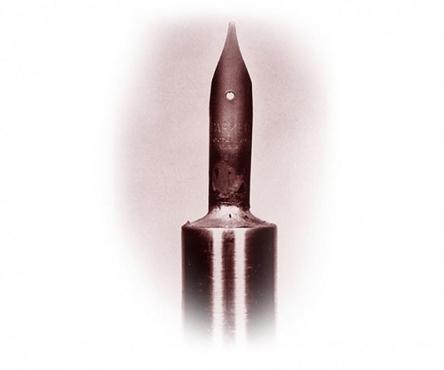
We find ourselves preparing for the next war when the ink is hardly dry on the still unratified Treaty of Peace.

These were the thoughts of the Japanese rulers who were terribly surprised to find that they had quickly become the subject of much attention by their former allies, the Americans and the Commonwealth powers following the close of the First World War.

Treaty of Versailles War-Guilt Clause article |Treaty of Versailles War-Guilt Clause History | Germany Outraged Over Treaty of Versailles War-Guilt Clause
1929, The Literary Digest, War Guilt

Germany’s Discomfort Over the War-Guilt Clause
(Literary Digest, 1929)

The Treaty of Versailles was signed ten years before the printing of the attached article, and within that time the German press had literally published hundreds of thousands of editorials objecting to the treaty’s clause that placed all blame entirely on Germany for the start of the war. In order to mark this anniversary, the editors of The Literary Digest decided to run this article that reported on how that country felt about the war-guilt lie.
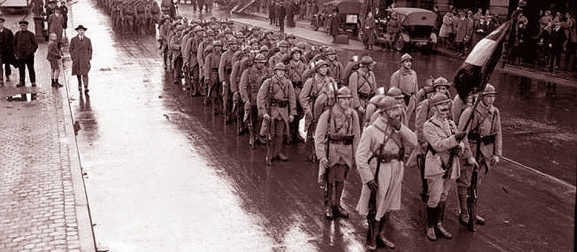
The French Army Moves into the Ruhr Valley (Literary Digest, 1923)
1923, The Literary Digest, Versailles Treaty

The French Army Moves into the Ruhr Valley
(Literary Digest, 1923)

When Germany’s post-war government failed to remit a portion of the 33 billion dollars it owed under it’s obligations agreed to in the Versailles Treaty, France lost little time deploying her army into the coal rich regions of the Ruhr Valley. This article, illustrated with cartoons and maps, offers a collection of assorted observations and editorial opinions gathered from from across Europe concerning the event:

Premiere Poincare remarked, ‘the French troops will remain in the Ruhr as long as may be necessary to assure the payment of reparations, but not a single day longer.’

Advertisement

Use shortcode [oma_ad position="summary_top"] (or other position) in your theme or widgets to display OMA Promotions here.

The Lynchings of 1934 (Literary Digest, 1935)
1935, Lynchings, The Literary Digest

The Lynchings of 1934
(Literary Digest, 1935)

Four paragraphs tallying up the number of lynchings that took place throughout the course of 1934. The study was compiled by the Department of Records and Research of the Tuskegee Institute, which also compared the amount to the number of lynchings that took place during the previous four years.

Fifteen people, all Negroes, were lynched during 1934…Mississippi led in the number of lynchings, six; Florida and Louisiana came next with two each; and one each was recorded for Alabama, Georgia, Kentucky, Tennessee, and Texas.

The World Navies Expand (The Literary Digest, 1937)
1937, The Literary Digest

The World Navies Expand
(The Literary Digest, 1937)

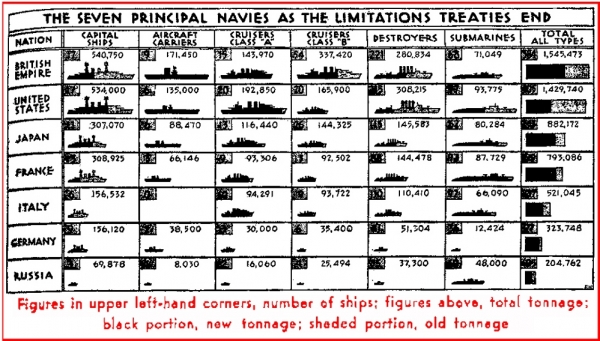
Here is a concise report illustrated by a chart that indicates the size and tonnage of the leading naval powers in 1937.

In 1922, when a halt was called on the vicious race for bigger and better battleships by conclusion of the Washington Naval Treaty, later supplemented by the London Pact of 1930, there were but five major sea powers: America, Britain, Japan, France and Italy. Today, the world picture has changed and two new faces are on the list, Nazi Germany and Soviet Russia.

All in all, as the treaties end, the United States Fleet stands on par, if not superior to, the armada of the British Empire…


Click here to read more about the expansion of the U.S. Navy.

Click here to read another article about the pre-WW II expansion of the world’s Naval powers.

Click here to read more about the demise of the Washington Naval Treaty.

HUAC Committee Communists in Hollywood | Hollywood 10 Newspaper Article
1947, Blacklisting

A Review of the Whole Show
(The Commonweal, 1947)

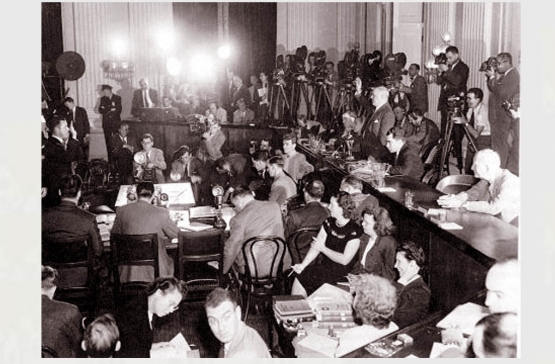
It seems so odd that that the House Un-American Activities Committee that convened to examine the communist influence in the Hollywood motion picture industry lasted only nine days – yet it is one of the most well-known of all the Congressional committees in the history of the republic. That said, we have posted one journalist’s summary of all the hearings:


Former investigations of this kind were mainly concerned with what people had done or not done; this investigation set a precedent by being concerned about what people thought.

Advertisement

Use shortcode [oma_ad position="summary_top"] (or other position) in your theme or widgets to display OMA Promotions here.

Armistice Cartoon (American Legion Weekly, 1919)
1915, Cartoons, Cartoons (WWI), The New York Times

Kultur
(The New York Times, 1915)

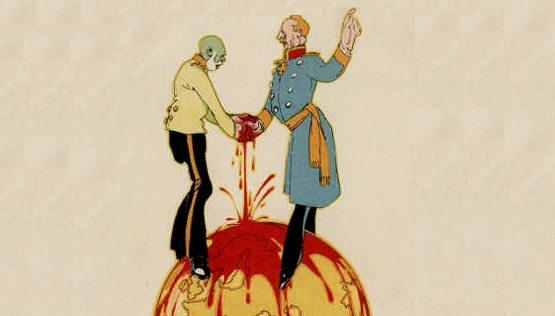
During the course of the Great War, few German terms delighted English speaking cartoonists more than the word kultur -which is the Teutonic word for civilization or cultural progress. Prior to being picked up by the New York Times, this cartoon originally appeared in a London magazine called, The Sketch, and was drawn by W. Heath Robinson (dates?).

Armistice Cartoon (American Legion Weekly, 1919)
Cartoons, Cartoons (WWI)

Armistice Cartoon
(American Legion Weekly, 1919)

A cartoon that appeared in an American veterans magazine on the first anniversary marking the last day of W.W. I. What is especially amusing is the satirical depiction of American combat officers and the last frame, which fully supports the thesis of Joseph E. Persico’s book, 11th Month, 11th Day, 11th Hour that the American Army was on the attack all the way up to the bitter end.

Advertisement

Use shortcode [oma_ad position="summary_top"] (or other position) in your theme or widgets to display OMA Promotions here.

Advertisement

Use shortcode [oma_ad position="summary_top"] (or other position) in your theme or widgets to display OMA Promotions here.

Advertisement

Use shortcode [oma_ad position="summary_top"] (or other position) in your theme or widgets to display OMA Promotions here.

Scroll to Top