















Military Expenditures: 1908 - 1913 (Literary Digest, 1935)
A printable chart, calculated in millions of U.S. dollars (evaluated prior to the 1934 value), which lays out the military spending as it increased between the years 1908 through 1913. The nations taken into account are Britain, France, Germany, Italy, Russia, Japan and the United States.
|
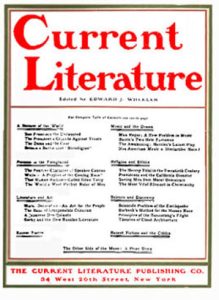
The German Threat to Russia (Literary Digest, 1913)
"The German military maneuvers have aroused the attention of Europe to the splendid equipment and administration of the Army, not only in the fighting spirit, but in the commissariat and its medical service."
-so begins the attached article which addressed the subject as to the general sense of intimidation and uneasiness that was brought on by the bristling display of might recently witnessed. The journalist muses about just what the Franco-Russian Alliance would mean in the face of such and an advanced military force and touches upon the size of the German Army compared with other forces in Europe -suggesting that France could never stand up to an attack.
|
French Insecurity and the Press Corps (Literary Digest, 1913)
A 1913 article from an American magazine in which the journalist reported on a strong sense of insecurity experienced by France as a result of Imperial German military hubris. The reporter illustrated the point with various quotes from French papers of the day and in a similar vein, sites a number of German papers that express an arrogant contempt for France.
|
|
|
Germany Defends It's Military Build Up (The Literary Digest, 1913)
A defense was offered for the growth of German military expenditures based on the spread of "Slavik pride" and the rise of a "great Pan-Slavonic movement" due to "victory of their kinsmen in the Balkans". German leaders, furthermore, felt a deep uneasiness about the fact that about one-third of the population of the Hapsburg Monarchy consisted of Slavs and therefore felt that military aid from the Austro-Hungarian Empire was not guaranteed in the event of a war with Russia and France.
|
The Baseless Fear of War by Andrew Carnegie (The Independent, 1913)
Andrew Carnegie (1835 - 1919) tried his hand at clairvoyance and wrote this article in response to the constant plea for money from the U.S. Department of War, which he found completely unnecessary and excessive.
"Our naval and military officials must dream of wars since most of them never even see one."
|
MORE ARTICLES >>> PAGE: * 1 * 2 * 3 * > NEXT |