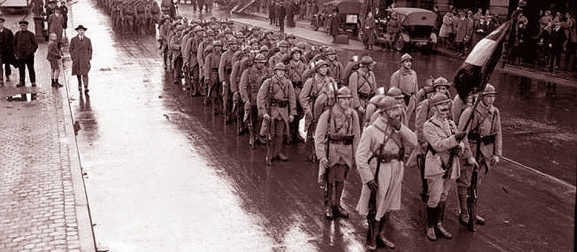
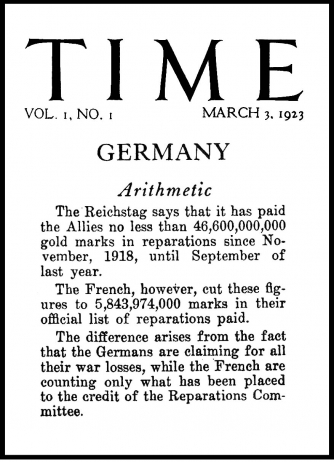
When Germany’s Weimar government failed to remit a portion of the 33 billion dollars it owed under it’s obligations agreed to in the Versailles Treaty, France lost little time deploying her army into the coal rich regions of the Ruhr Valley. This article, illustrated with cartoons and maps, offers a collection of assorted observations and editorial opinions gathered from across Europe concerning the event:
“The Frankfurter Zeitung cries out against France’s action as ‘one of pure violence,’ which ‘we must suffer to-day, but we know that sooner or later this violence will be terribly avenged on those who have exercised it and those who have consented to it.’
“Premiere Poincare remarked, ‘the French troops will remain in the Ruhr as long as may be necessary to assure the payment of reparations, but not a single day longer.'”
The French Army decamped in 1930.
A war veteran named Adolf Hitler had some opinions about the 1923 Ruhr occupation, click here to read about him.

reparations clause treaty of versaillesOccupation of the Ruhr 1923magazine news article about the French army Occupation of the Ruhr 1923Germany misses reparation payment and France invaded Germany's Ruhr Valley 1923French President Poincare invades Rurh 1923Coal-heavy region of Germany occupied by France 1923Industrial area of Germany occupied by Germany 1923Premiere Poincare remarks about Ruhr occupation 1923European opinion concerning Ruhr occupation 1923cartoons about Ruhr occupation 1923Ruhr occupation as a topic of editorial opinion 1923Weimar Germany and its sympathizers during Ruhr occupation 1923
![When the French Army Seized the [br]Ruhr Valley](https://oldmagazinearticles.com/pdf/Ruhr-Valley_Occupation_0001.jpg)
![When the French Army Seized the [br]Ruhr Valley](https://oldmagazinearticles.com/pdf/Ruhr-Valley_Occupation_0002.jpg)
![When the French Army Seized the [br]Ruhr Valley](https://oldmagazinearticles.com/pdf/Ruhr-Valley_Occupation_0003.jpg)
![When the French Army Seized the [br]Ruhr Valley](https://oldmagazinearticles.com/pdf/Ruhr-Valley_Occupation_0004.jpg)
reparations clause treaty of versaillesOccupation of the Ruhr 1923magazine news article about the French army Occupation of the Ruhr 1923Germany misses reparation payment and France invaded Germany's Ruhr Valley 1923French President Poincare invades Rurh 1923Coal-heavy region of Germany occupied by France 1923Industrial area of Germany occupied by Germany 1923Premiere Poincare remarks about Ruhr occupation 1923European opinion concerning Ruhr occupation 1923cartoons about Ruhr occupation 1923Ruhr occupation as a topic of editorial opinion 1923Weimar Germany and its sympathizers during Ruhr occupation 1923